- Cost Per Canadian
- Posts
- Cost Per Canadian for June 26th
Cost Per Canadian for June 26th
🕵️ A true-crime ad-spend podcast is in the making

Frazer Black
June 26, 2024
Cost Per Canadian for June 26th
Presented by Point Blank
$140,522 was spent on Meta last week by the top ten advertisers, reaching people across Canada. In this week’s edition of Cost Per Canadian, we uncover an interesting new wrinkle in the case of the Affordability Advocates page and very graciously thumb our noses at a different page that has been taken down ahead of an upcoming law change.
Frazer, Digital Director. Point Blank
Seven-Day Ad Spend
(15th June - 21st June)
Page | Spend | Affiliation |
|---|---|---|
$21,286 | 🇨🇦 CA CPC | |
$18,056 | 🇨🇦 CA CPC | |
$17,851 | ||
$13,518 | ||
$12,788 | ||
$12,628 | ||
$12,334 | ||
$11,841 | ||
$10,387 | ||
$9,833 |
Seven-Day Ad Spend By Federal Party
(15th June - 21st June)
Party | Spend |
|---|---|
🔵 Conservative Party of Canada Including spend by the leader. | $39,342 Steady (Up 3%) |
🔴 Liberal Party of Canada Including spend by the leader. | $9,824 Up 52% |
🟠 New Democratic Party of Canada Including spend by the leader. | $3,809 Steady (Up 3%) |
🟢 Green Party of Canada Including spend by the leader. | $2,150 |
Noted:
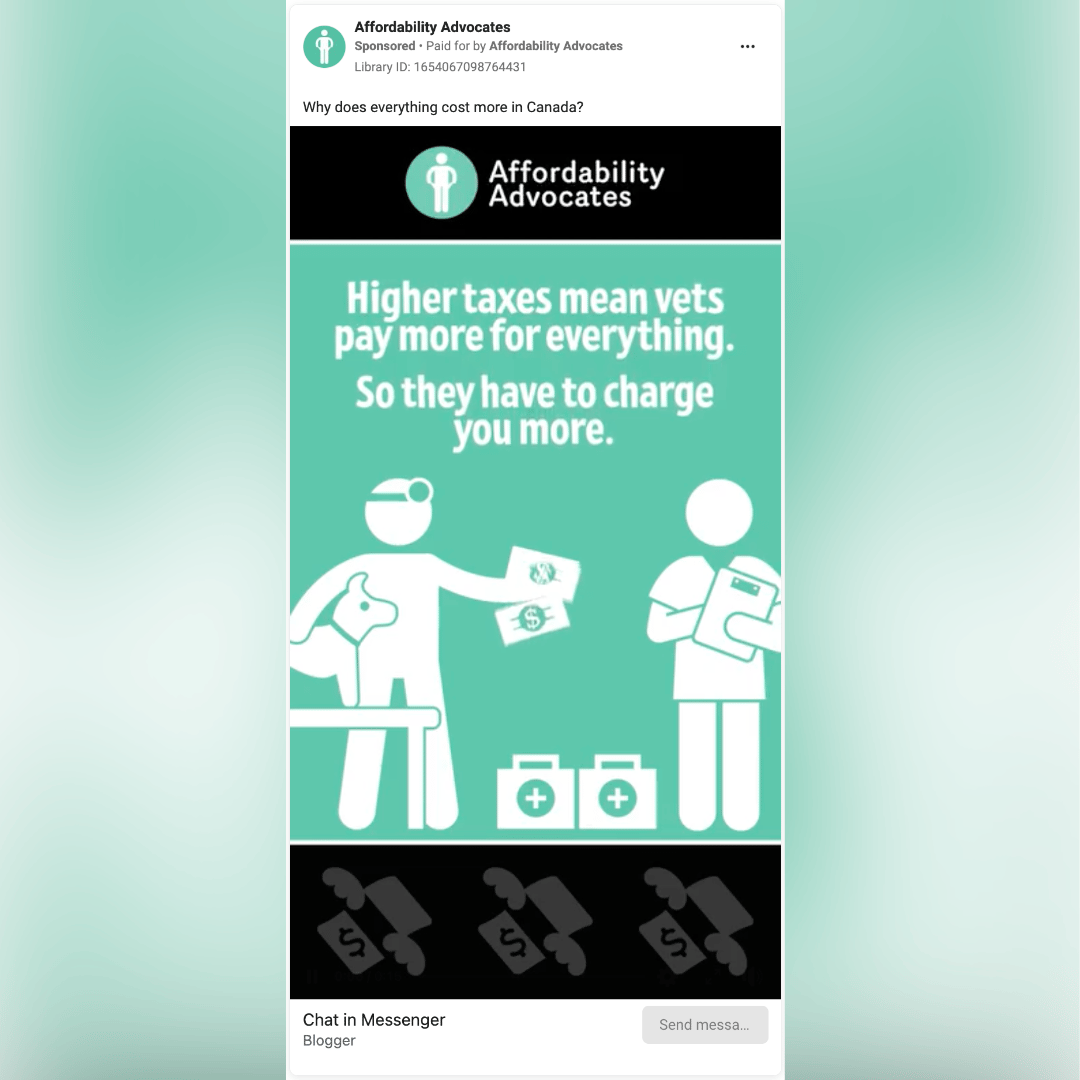
Affordability Advocates have popped up again, this time with a video ad about the cost of pet care.
After taking a few weeks off, the Affordability Advocates page is back with some new, equally bleak ads. We’ve written previously about their ads and speculated on some of the strategies that could be at play here to support parties on the right, including using these ads to feed into audience targeting elsewhere.
We’re still no clearer on who’s responsible for the page and the very high budget it’s commanding, but this latest suite of ads has uncovered two interesting new details:
For these ads, the page has specifically excluded any postal code that falls within the riding of Toronto St Paul’s, which went to the polls on Monday. This indicates that the page owners are very intentionally trying to avoid a situation where they’d need to officially declare their spending to Elections Canada (and out themselves as a result).
Another page, Fair Share Report, has shared exactly the same targeting strategy over the past seven days.

Fair Share Report’s most recent ad.
Fair Share Report has also been running bleak (though much less so) ads for a while. The most recent ad suggests that Canada is doing more than its fair share regarding emissions and that we have nothing to show for it.
In theory, this may be just a coincidence; however, the odds of two advertisers choosing the same postal codes to exclude as part of a national campaign that also excludes Quebec and has no other interest-based targeting seems slim at best. Adding to this:
Both pages were created within a week of each other in February of this year
Both pages launched portrait video ads on the 12th of June
Over the last ninety days, they have spent nearly an identical amount of money ($86,727 / $86,854)
More likely, we believe these pages are being funded and managed by the same groups with the same goals in mind. Unfortunately, there’s nothing more we can glean from either page to shed more light on who those groups are. We’ll continue to monitor their activity and return to this topic again if there’s more to share.
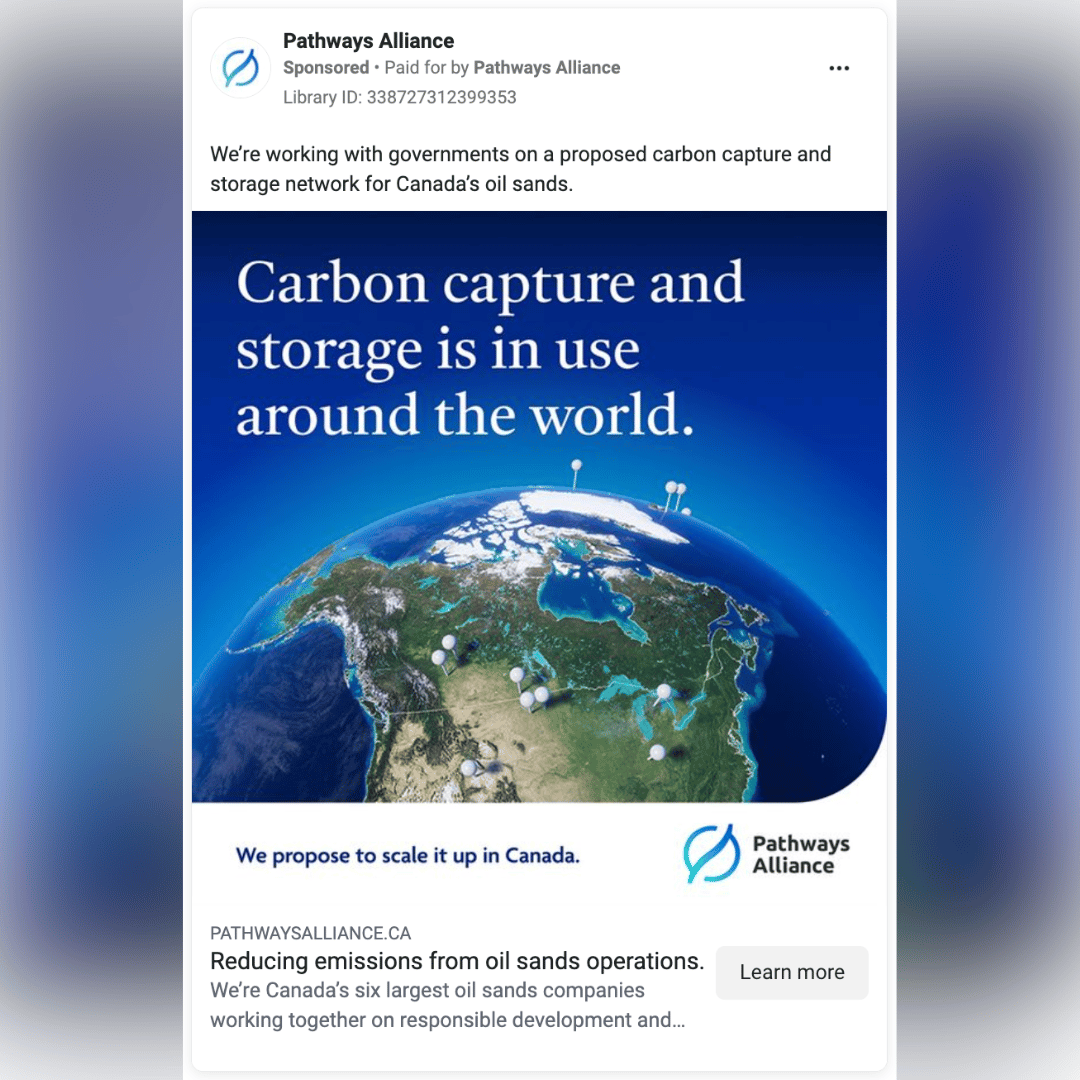
One of the ads Pathways Alliance has been running until very recently.
Pathways Alliance, one of the largest spenders over the last three months, has pulled all their ads ahead of a law change designed to prevent corporate greenwashing.
Keith Brooks, programs director with the advocacy group Environmental Defence, characterized Pathways' removal of content as being essentially "an admission of guilt."
"If you want to be advertising and touting some green credentials, then those credentials need to be substantiated. You need to have some evidence to show that this is actually what's happening. You can't just be talking about it," Brooks said.
The clean energy think-tank Pembina Institute, meanwhile, wrote that its research and analysis had been identifying "significant gaps" between the emissions reduction promises the Pathways Alliance first made in 2021 and their actions to deliver those promises.
"It remains the case that the group has yet to make any final investment decisions on carbon capture projects, or on other technologies, that would meaningfully reduce their emissions in line with their previously stated 2030 and 2050 targets — despite the existence of significant public subsidies to support such investments," reads a statement from MC Bouchard, oil and gas program director at the Pembina Institute.
The digital advertising landscape in 2024 is so precisely targeted that for many people, it’s impossible to know which ads your neighbours, friends and family are being influenced by. We track the biggest spenders and hig-profile campaigns every week on Meta, keeping you in the loop with what the rest of Canada is seeing.
More from Point Blank
 5 truths progressives can’t afford to ignore. As more and more conservative politicians rally their bases and pull supporters from across the political spectrum… more. |  Are we wrong all the time? Everyone has biases. It’s not something we can change. But when it comes to developing effective campaigns, bias is something we have to… more. |  When should you start planning for the BC election? Right now. No matter where your organization falls on the political spectrum, or what your relationship… more. |
